Tisza ETT
hírek
Launch of the “Bridge2EastCE – Bridge to the East” Project
Information
The Institute for Strategic Studies, in connection with the ministerial commissioner duties of its President, has successfully submitted a proposal titled “Bridge2EastCE – Bridge to the East” under the third call of the Interreg Central Europe Programme. The aim of the Bridge2EastCE project is to examine the impacts of the Russia–Ukraine war on EU peripheral regions bordering Ukraine, and to promote cooperation and coordinated development planning among them. This will be achieved through the creation of an interregional framework involving four countries—Poland, Slovakia, Hungary, and Romania—to strengthen the “bridge” role of these border regions and make use of the opportunities arising from it.
The implementation of the Bridge2EastCE project began on 1 February 2026 and will run for two years.
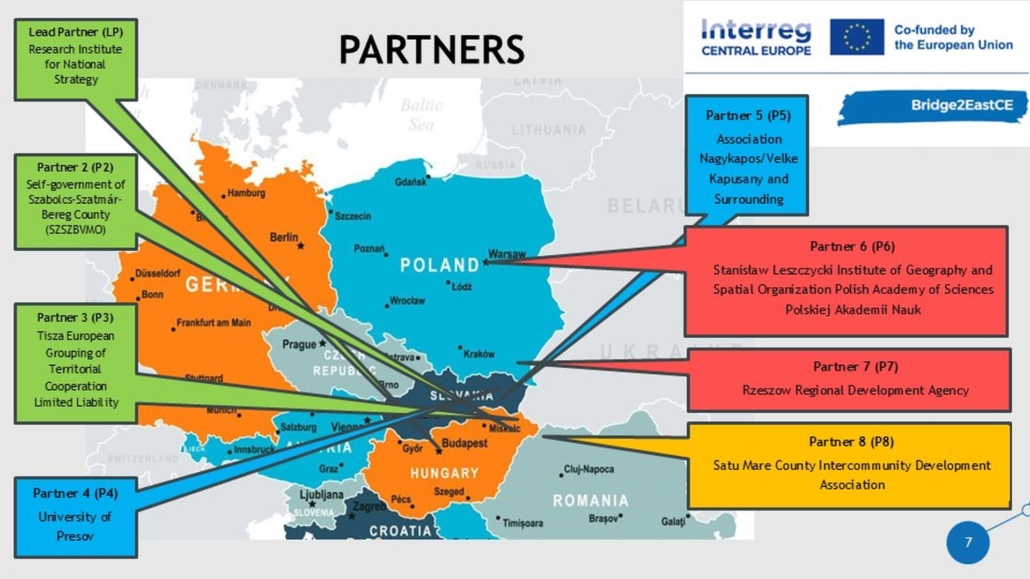
The project seeks to enhance cross-border dialogue, strengthen professional cooperation, identify joint development opportunities, and promote knowledge exchange between regions through the joint efforts of a partnership consisting of 11 members—8 full partners and 3 associated partners. Led by the Institute for Strategic Studies, the project brings together partners from five countries, forming a unique cooperation network among regional actors and knowledge institutions.
The regional partners—the Tisza EGTC (HU), the Szabolcs-Szatmár-Bereg County Municipality (HU), the Rzeszów Regional Development Agency (PL), the Satu Mare Community Development Association (RO), and the Nagykapos and Region Association (SK)—are closely connected to the areas where development interventions are most needed. Their local experience helps better understand the challenges and opportunities of these regions.
At the same time, the knowledge partners—the Institute for Strategic Studies (HU), the University of Prešov (SK), and the Stanisław Leszczycki Institute of Geography and Spatial Organization of the Polish Academy of Sciences (PL)—provide methodological and professional support, contributing to the development of innovative solutions.
The project is also supported by three associated partners: the University of Pannonia (HU), the Carpathian Region of Vojvodina (PL), and the Association of Border Municipalities of Carpathia (UA).
The source of the news is available at this and this link.