
European perspective
literature
Information
Author
Martina Eckardt, Stefan Okruch
Year of publication
2019
Language
English (EN)
Download
Share
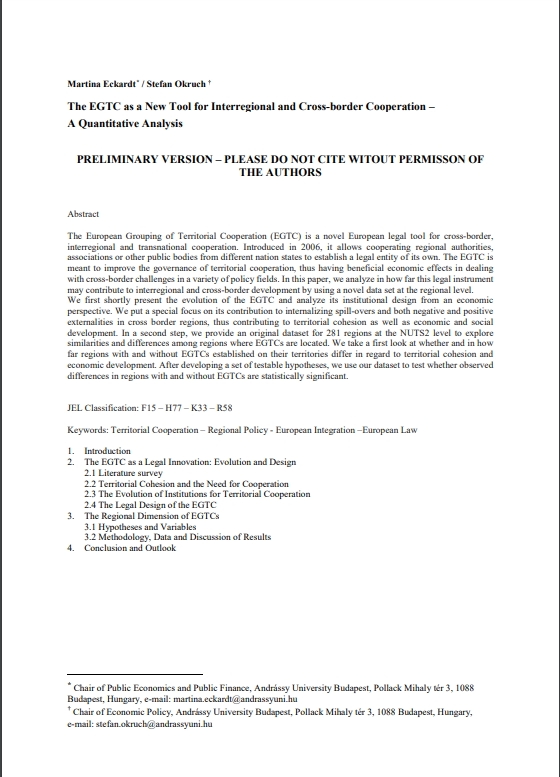
The EGTC as a New Tool for Interregional and Cross-border Cooperation – A Quantitative Analysis
Abstract
The European Grouping of Territorial Cooperation (EGTC) is a novel European legal tool for cross-border, interregional and transnational cooperation. Introduced in 2006, it allows cooperating regional authorities, associations or other public bodies from different nation states to establish a legal entity of its own. The EGTC is meant to improve the governance of territorial cooperation, thus having beneficial economic effects in dealing with cross-border challenges in a variety of policy fields. In this paper, we analyze in how far this legal instrument may contribute to interregional and cross-border development by using a novel data set at the regional level. We first shortly present the evolution of the EGTC and analyze its institutional design from an economic perspective. We put a special focus on its contribution to internalizing spill-overs and both negative and positive externalities in cross border regions, thus contributing to territorial cohesion as well as economic and social development. In a second step, we provide an original dataset for 281 regions at the NUTS2 level to explore similarities and differences among regions where EGTCs are located. We take a first look at whether and in how far regions with and without EGTCs established on their territories differ in regard to territorial cohesion and economic development. After developing a set of testable hypotheses, we use our dataset to test whether observed differences in regions with and without EGTCs are statistically significant.