
Literature of particular Hungarian EGTCs
literature
Information
Author
Sara Svensson
Year of publication
2013
Language
English (EN)
Download
Share
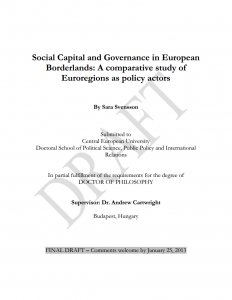
Social Capital and Governance in European Borderlands: A comparative study of Euroregions as policy actors
Abstract
The dissertation contributes to the literature on multi-level governance in Europe and on borderlands by investigating the mechanisms of local cross-border policy making. It focuses on motivation, participation and interaction patterns of one type of actors, namely, the local governments that constitute the backbone of much institutionalized cross-border cooperation in Europe. As local governments, especially the small ones, are frequently neglected by researchers tending to focus on actors representing regional actors or major towns. The research argues that paying more attention to their attitudes and behaviour can enhance our understanding of the variation in the function and performance of institutions often referred to as Euroregions.
The dissertation uses the concept of social capital (as understood by Coleman, 1990) and addresses two specific questions: (1) Why and how do local governments participate in cross-border cooperation institutions (Euroregions) and how do they interact? (2) Can motivation, participation and interaction patterns generate social capital that influences how the functioning and performance of Euroregions?
The dissertation relies on an extensive dataset consisting of more than 200 interviews. The core is given by 136 interviews with political representatives (mayors) and organizational representatives (chairs and managers) of six Euroregions located along three national borders that do not pose obstacles in terms of cultural-linguistic, economic development or politico-administrative differences, (Hungary/Slovakia, Sweden/Norway and Austria/Germany), thereby holding constant important factor that could affect the outcome.
A mixed-method approach is used in the analysis of the data, combining qualitative analysis with social network analysis. The results demonstrate that motivation of local government for joining and maintaining a membership in a Euroregion is more frequently based on normative than on instrumental factors. Dense participation and communication patterns, indicating presence of social capital, are not clearly associated with high cross-border cooperation intensity, but for Euroregions to be evaluated favourably by its own members, both within-group (domestic) and between-group (transnational) social capital matters. Inter-municipal cooperation is a resource that plays an important role both at the time of Euroregional formation and later into its operation, and dense communication networks on one side of the border are related to how actively and engaged the members become in the Euroregional organization. Moreover, normative motivation is more conducive for the creation of social capital than instrumental motivations; especially grant-driven expectations can lead to output legitimacy problems if not fulfilled.
The dissertation therefore argues that high levels of within-group social capital serve as a pre-condition for high levels of between-group social capital. However, the evidence could not be found to support the expectation that a high-level of between-group social capital in the form of cross-border communication is associated with high organizational performance in the form of cross-border cooperation intensity. While social capital may still be important for Euroregional function and long-term performance (it is likely to enhance the chance for organizational survival), hence there is no clear evidence that it has an impact in the short timespan within which most Euroregions have operated so far.
